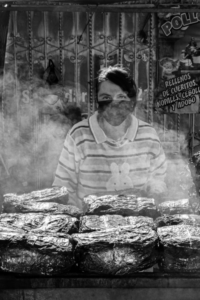
Stop along the way in Ixtlahuaca on our way to San Juan Teotihuacán, State of Mexico, Mexico. We met a local vendor, Juan-Jose Mendoza, who closed his ferreteria (hardware store) and opened a taco and burrito shop. We met him on the day before the weekend he was scheduled to open. He spoke excellent English, and had said he worked for a car dealer in California for nearly two decades while he awaited his legal immigration to complete. When he received his immigration, he stayed with the company for another 13 years. I met many Mexican citizens that had dual citizenship and lived and worked several years in the USA legally. Each of them emphasized how important it was to them that the USA continue to remain diligent in continuing the same standards for immigration that they experienced, referencing the process should apply to everybody, and even Mexico has a rigorous process to gain citizenship.
It had been a long morning, catching a bus in Temascalapa and traveling for two hours to Ixtlahuaca. If you have had the opportunity to enjoy the rural transportation system of Mexico, you are aware how grueling two hours on a public bus can be. Breakfast was at about 6:00am and we caught the bus at around 8:00am. Once we passed through Ixtlahuacan there were going to be very few food options available until the return to Temascalapa.
Jose referred us to another vendor near the plaza that was along the way from our first bus drop-off point and the seven blocks to the next bus station that would be the pick-up point to continue to Teotihuacan. We stopped at this vendor and enjoyed a brief break before continuing to the bus stop on the other side of the plaza.

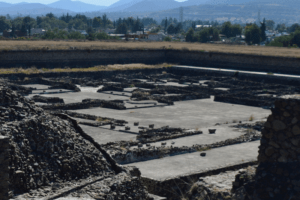
Rafael was an excellent host and guide, and Jill, Jessie and I were enjoying every free moment we had with “Rafa” Rejos whether it was at the Hostel in Temascalapa or visiting the local markets. When we arrived to San Juan Teotihuacán it was very impressive to say the least. We climbed several of the ancient ruins including the Temple of the Sun and the Temple of the Moon. Walking across the ruins landscape was humbling to say the least. One couldn’t help but to reflect upon the ancient civilizations that inhabited the area long before the European ethnic cleansing period occurred. This citadel had to have required laborious man power that many of us today cannot fathom even in our most creative imagination.
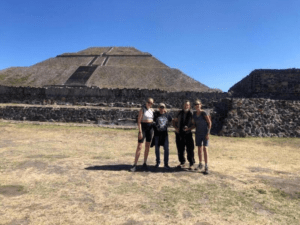
Jill, Rafa, me and Jessie posed for our picture with one temple in the background that was 800 meters away. This gives you an idea of the magnitude of the pyramid and the structures enveloping them. The number of stones used to build a wall, much less a temple, are unimaginable. Even more is transporting the stones from the surrounding areas to the pyramid site is even more unimaginable. Certainly, there were few too many stones in the immediate area to build such a magnificent infrastructure. At the site there was housing facilities and cultural center that purportedly was a gathering center for the ancient civilizations. More impressive than this site was Machu Picchu in Peru, where I had similar considerations and couldn’t help but wonder how these civilizations may have once been related to one another and possibly conducted trade across continents.
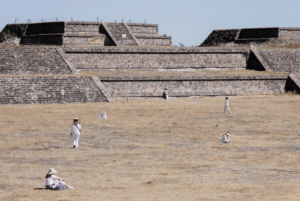
Our final stop was the citadel. Granter, this holy city of Teotihuacan – where the gods were created – is a pre-Columbian artifact and more than likely collapsed during Meso America conflicts. It has been suggested that the state was not in decline prior to its collapse, but it fell under its own weight, being incapable of militarily incorporating every independent city into a Teotihuacan empire.
The pre-urban structures of ancient Mexico and human occupation of the valley of Teotihuacan began before the Christian era. Sometime between the 1st and the 7th centuries A.D. the settlement developed into one of the largest ancient cities in the Americas, the population comparable to a small city having an estimated population of at least 25,000 inhabitants.
Elements of the Teotihuacan empire included the Teotihuacan Valley with the San Juan River, was altered to cross the Avenue of the Dead. This north-south oriented main reference axis of the city is lined with monumental buildings and complexes, from which the Pyramids of the Sun and the Moon, and the Great Compound with the Temple of Quetzalcoatl (Temple of the Plumed Serpent) majestically rise.
Following the nearly 4 hours touring the Temple where the Gods wer created, it was time to catch another bus and return to Temascalapha. We decided to take the long route back and boarded around 2:00pm. Following the first hour of travel, we had to switch buses in another village along the way. This was where we had our final snack for the day. Jessie captured an incredible photograph of a street vendor as she operated the food-cart on the road side. In this rare image, it represents much of the cultural experiences had throughout my travels.